The WSJ has a report on what is being fed to Pigs and cows now that corn is more expensive.
A very strange thing is happening right now in livestock operations in the United States. As corn becomes a hot commodity for ethanol production, livestock producers are replacing some of their animal feed with products that would look more at home in the candy aisles of supermarkets. According to a recent Wall Street Journal report, producers are feeding their cows and pigs an odd assortment of junk food, including hard candy, trail mix, licorice, chocolate bars, French fries, and cheese curls, among other things.
Why would farmers mix sugary, salty, and high-fat foods into animal feed? Corn prices have jumped to $4 a bushel, twice the level of just a few years ago. And as corn prices go up, it means that farmers have to pay more to get their animals to slaughter weight. They have found, not surprisingly, that tater tots, peanuts, and chocolate chips can pack on the pounds. Some cattle producers have replaced 100 percent of their feed with discarded junk food.
More than half a century ago, the livestock industry started messing with animals’ diets, confining them indoors, and replacing their natural grass diet with a high-protein diet of grain. Why? Thanks to subsidies that encouraged overproduction, corn and soybeans were cheap. But today, with these inputs not quite as alluring, it’s somehow become cost effective to feed livestock—the very animals that eventually end up on our dinner plates—discarded junk food. That’s definitely not a step in the right direction
Thursday, May 24, 2007


Osram LED's for Opel head lamps

Osram has developed exterior lighting for a concept car using new thin film Ostar and golden dragon LED's. Quite an achievement given the light output required. From the article
LEDs from Osram Opto Semiconductors have been used for all the exterior lighting on the Opel GTC concept car. Using thin-film LED chip technology, Osram says that its LEDs have received a huge boost in brightness, which reduces the number of devices needed for each specific lighting application.
In each headlight, two Ostar LEDs are used for the dipped beam, with three further OSTAR LEDs providing the high beam.
Parking lights and daylight running lights (DRLs) are provided by Golden Dragon LEDs, and each fog light is equipped with one Ostar LED. For the interior lighting, red TopLEDs from Osram were featured to backlight the dashboard instruments, accen-tuating and complementing the red design accents on the steering wheel and seats of the sports coupe.
In addition, LEDs are utilized in automobiles to increase road safety. These compact light sources have a quicker response time and are brighter than incandescent lamps, factors which contribute to the safety of passengers, par-ticularly in instances when sudden braking is called for.
LEDs give car designers new freedom to give the front and rear light clusters an eye-catching make-over. The front of the Opel GTC is a good example with its large vertical air intakes and trapezoidal grille giving it a smooth yet aggressive appearance.
Wednesday, May 23, 2007
Wake up Aussies
The BBC reports that the Australian wheat exports have been badly hit by the worst drought in the century. Point is every ton of wheat requires 100's of tons of water to grow. In effect that aussies are exporting the very water that they can ill afford to. The Murray-Darling basin is finished and the water available is barely enough to drink. Finally the ills of food export are catching up with mankind. Food should be locally grown and consumed. For residents of the worlds driest continent to ravage their land in the name of economic development is akin to Kalidasa cutting the branch while sitting on it. The meat & wool business is even more dangerous from the sustainability perspective. It takes 500 tons of water for one ton of beef !
Food or Fuel
More on the corn ethanol issue. Clearly the effects of using a major food crop for fuel has already being felt in the America's. While these are still early days to draw firm conclusions, the trend emerging is clearly scary. One wonders if corn ethanol is a transportation strategy or a population control program. The numbers seem to indicate that the average US grocery basket was dearer by $47/month due to the increased demand for corn as fuel. Read more here.
Tuesday, May 22, 2007
Gold from waste - new twist to 'data' mining
The implications of e-waste are becoming clear day by day. For the record e-waste has 17 times more gold that gold bearing ore and 40 times more copper. Given the prices of metals it looks like mining refineries may soon switch to extracting the metals from waste rather than mining it. China seems to have a lead in this (basically no environmental) with pesants doing this for peanuts. India has a strong recycling industry (informal) and safe e-waste treatment may be the way to go. There are however caveats as the environmental costs are high. This needs to be addressed urgently. In fact e-waste should be recycled in areas where hazardous industries are already using similar processes for different purposes so that the effluent treatment can be centralized and the investments amortized faster.
Monday, May 21, 2007
Hydrogen economy : Ga & Al
Physorg reports
Purdue researchers demonstrate their method for producing hydrogen by adding water to an alloy of aluminum and gallium. The hydrogen could then be used to run an internal combustion engine. The reaction was discovered by Jerry Woodall, center, a distinguished professor of electrical and computer engineering. The method makes it unnecessary to store or transport hydrogen - two major challenges in creating a hydrogen economy, said Jerry Woodall, a distinguished professor of electrical and computer engineering at Purdue who invented the process. The hydrogen is generated on demand, so you only produce as much as you need when you need it," said Woodall, who presented research findings detailing how the system works during a recent energy symposium at Purdue.
The technology could be used to drive small internal combustion engines in various applications, including portable emergency generators, lawn mowers and chain saws. The process could, in theory, also be used to replace gasoline for cars and trucks, he said.
Hydrogen is generated spontaneously when water is added to pellets of the alloy, which is made of aluminum and a metal called gallium. The researchers have shown how hydrogen is produced when water is added to a small tank containing the pellets. Hydrogen produced in such a system could be fed directly to an engine, such as those on lawn mowers.
"When water is added to the pellets, the aluminum in the solid alloy reacts because it has a strong attraction to the oxygen in the water," Woodall said.
This reaction splits the oxygen and hydrogen contained in water, releasing hydrogen in the process.
The gallium is critical to the process because it hinders the formation of a skin normally created on aluminum's surface after oxidation. This skin usually prevents oxygen from reacting with aluminum, acting as a barrier. Preventing the skin's formation allows the reaction to continue until all of the aluminum is used.
Purdue researchers demonstrate their method for producing hydrogen by adding water to an alloy of aluminum and gallium. The hydrogen could then be used to run an internal combustion engine. The reaction was discovered by Jerry Woodall, center, a distinguished professor of electrical and computer engineering. The method makes it unnecessary to store or transport hydrogen - two major challenges in creating a hydrogen economy, said Jerry Woodall, a distinguished professor of electrical and computer engineering at Purdue who invented the process. The hydrogen is generated on demand, so you only produce as much as you need when you need it," said Woodall, who presented research findings detailing how the system works during a recent energy symposium at Purdue.
The technology could be used to drive small internal combustion engines in various applications, including portable emergency generators, lawn mowers and chain saws. The process could, in theory, also be used to replace gasoline for cars and trucks, he said.
Hydrogen is generated spontaneously when water is added to pellets of the alloy, which is made of aluminum and a metal called gallium. The researchers have shown how hydrogen is produced when water is added to a small tank containing the pellets. Hydrogen produced in such a system could be fed directly to an engine, such as those on lawn mowers.
"When water is added to the pellets, the aluminum in the solid alloy reacts because it has a strong attraction to the oxygen in the water," Woodall said.
This reaction splits the oxygen and hydrogen contained in water, releasing hydrogen in the process.
The gallium is critical to the process because it hinders the formation of a skin normally created on aluminum's surface after oxidation. This skin usually prevents oxygen from reacting with aluminum, acting as a barrier. Preventing the skin's formation allows the reaction to continue until all of the aluminum is used.
OLED's at work

A beautiful (that is the right adjective) new keyboard the Optimus has raised the humble keyboard to the the next level. Each key is a complete bitmapped OLED display that allows any character, image or bit map to be assigned to the key. For people who use scripts other than latin this is a major move forward. Yet another amazing LED application.
Friday, May 11, 2007
Commercial : Innovative new off-grid product

Alternate Lighting has introduced a battery backed low cost LED table lamp in AC and Solar chargeable formats. The lightweight 7 LED lamp is targeted at rural households (and given the current power scenario, even metros :) and provides upto 3 hours of off-grid operation. Comes with a built in Ni-Cd battery pack and charger electronics. Quite a unique and off-beat product (even if i have to say so myself :) The lamps are available for online purchase on eBay.
Autonomous valve train & HCCI
A new idea from Purdue seems to be the next big thing in making the IC engined (petrol) auto a bit more eco-friendly. The concept is based on variable valve timing that is facilitated by an autonomous power and control system for the valve train ( i wonder if this can be called a valve train as it has not connection with the crankshaft). The kicker seems to be the fact that the more granular valve control independent of the timing allows the implementation of homogeneous charge compression ignition that in turn pushes up efficiency by about 20 %. Read more here.
Tuesday, May 08, 2007
nature: quantum karma - super massive supernovae
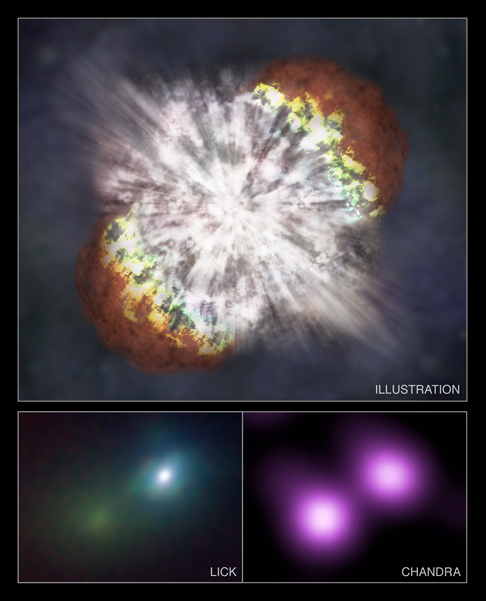
What defines krazilec ? Surely leto-2 was referring to super massive supernovae! The natural universe, if obeserved, far exceeds mere human inventivness in granduer. Behold a 150 solar mass super nova and reflect on your physical universe..
Read more below
Berkeley (May 7th, 2007) An exploding star first observed last September is the largest and most luminous supernova ever seen, according to University of California, Berkeley, astronomers, and may be the first example of a type of massive exploding star rare today but probably common in the very early universe.
Unlike typical supernovas that reach a peak brightness in days to a few weeks and then dim into obscurity a few months later, SN2006gy took 70 days to reach full brightness and stayed brighter than any previously observed supernova for more than three months. Nearly eight months later, it still is as bright as a typical supernova at its peak, outshining its host galaxy 240 million light years away.
UC Berkeley post-doctoral fellows Nathan Smith and David Pooley estimate the star's mass at between 100 and 200 times that of the sun. Such massive stars are so rare that galaxies like our own Milky Way may contain only a dozen out of a stellar population of 400 billion.
"This was a truly monstrous explosion, a hundred times more energetic than a typical supernova," said Smith, who led a team of astronomers from UC Berkeley and the University of Texas. "That means the star that exploded might have been as massive as a star can get, about 150 times that of our sun. We've never seen that before."
"Of all exploding stars ever observed, this was the king," said Alex Filippenko, UC Berkeley astronomer and leader of the ground-based observations at the University of California's Lick Observatory in California and the W. M. Keck Observatory in Hawaii. "We were astonished to see how bright it got, and how long it lasted."
Based on the Lick and Keck observations, plus data from the Chandra X-ray Observatory, Smith, Pooley, Filippenko and their colleagues argue that the stellar explosion was not your run-of-the-mill supernova, but a possible pair-instability supernova.
Stars with masses at least 10 times greater than our sun end their lives after burning hydrogen to helium, helium to carbon, and on to larger elements until they reach iron, when fusion stops. Toward the end of this process, the heat produced in the core of the star becomes insufficient to support the outer layers, which collapse inward, finishing the fusion process and crunching the core to a neutron star or black hole. The outer layers of the star are blown off in a bright flare-up we observe as a supernova.
For stars much more massive than this, ranging from 140 solar masses to as many as 250, the temperature at the core becomes so great that before the fusion cascade is complete, high-energy gamma rays in the core start annihilating one another, creating matter-antimatter pairs, mostly electron-positron pairs. Since gamma radiation is the energy that prevents collapse of the outer layers of the star, once the radiation starts disappearing, the outer layers fall inward. The net result is a thermonuclear explosion that, theoretically, would be brighter than any typical supernova. In this type of supernova, the star is blown to smithereens, leaving behind no black hole.
"This discovery forces us to go back to the drawing board to understand how the most massive stars die," Smith said. "Instead of just winking away into a black hole, they apparently can suffer these brilliant explosions that can be seen far across the universe. The fact that this thing is so bright, and stayed bright for a long time, makes our chances of detecting them in the early universe much better."
Such pair-instability supernovas should theoretically produce a greater percentage of heavy elements. According to Smith, the radioactive decay of
nickel-56 produces most of the light of a supernova, and this pair-instability supernova produced about 20 solar masses of nickel, compared to maybe 0.6 solar masses in a Type Ia supernova. Astronomers think that a large proportion of the universe's first stars were supermassive stars like this that, upon exploding, seeded the early universe with the heavy elements from which planets and later, humans, were made.
"We may have witnessed a modern-day version of how the first generation of the most massive stars ended their lives, when the universe was very young," Filippenko said.
The star that produced SN 2006gy apparently expelled a large amount of mass prior to exploding, reminiscent of the star eta Carinae, a so-called luminous blue variable which, at 100 to 120 solar masses, is the most massive star in our galaxy.
"This is also very exciting because it suggests that eta Carinae, only 7,500 light years away, might possibly explode in a similar manner, becoming a spectacularly bright star in our sky," Filippenko said.
"We don't know for sure if Eta Carinae will explode soon, but we had better keep a close eye on it just in case," added Mario Livio of the Space Telescope Science Institute in Baltimore, Md., who was not involved in the research. "Eta Carinae's explosion could be the best star-show in the history of modern civilization."
University of Texas graduate student Robert Quimby first observed the supernova on Sept. 18, 2006 in the galaxy NGC 1260, located in the constellation Perseus. Filippenko's team immediately began observing it with its dedicated supernova search and monitor telescope at Lick, the Katzman Automatic Imaging Telescope.
Filippenko and his graduate student Ryan Foley subsequently obtained spectra of the star using the Lick 3-meter Shane telescope and the DEIMOS spectrograph mounted on the Keck II telescope.
Pooley led the Chandra observation, which allowed the team to rule out the most likely alternative explanation for the supernova, namely that it was an explosion of a white dwarf star into a dense, hydrogen-rich environment.
"If that were the case, this supernova would have been 1,000 times brighter in X-rays than what we detected with Chandra," said Pooley. "This must have been an extremely massive star."
"In terms of the effect on the early universe, there's a huge difference between these two possibilities," said Smith. "One pollutes the galaxy with large quantities of newly synthesized elements, and the other locks them up forever in a black hole."
"One exciting repercussion of this is that, if pair-instability supernovas really are this bright, it gives us hope that the James Webb Space Telescope might actually be able to detect these explosions from the first stars, thereby verifying that they may actually exist," he added.
Monday, May 07, 2007
Solid State ! really

Sheets of glass with a veneer of natural stone backlit by LED's! this is solid state lighting through and through. The light sources are good enough to illuminate the stone and bring out its natural beauty from inside. From the LED Mag article
Lighting designers Chaos Design Consultants have installed an illuminated bar in the atrium of the Hilton Hotel, Heathrow.
Dancer’s Bar consists of 9 panels of a special product consisting of a thin veneer of real natural stone, which is bonded on to glass, the end result being beautiful translucent panels.
In order to produce the "floating" effect required by the client, Chaos installed panels of Prismex behind the veneer of natural stone and then edgelit each panel with a total of 450 white LEDs.
Prismex is an ultra-slim acrylic which makes it ideal to use where space is at a minimum. The acrylic also has a special pattern printed on it, which allows the light to be picked up and evenly spread across the panels.
Techwatch: Nano light sources
The nano buzz around lighting is getting louder. Cornell announces the development of nano-light emitting fibers that could revolutionalize lighting and especially LCD backlighting as we know it. I guess we should welcome 'the sheet screen' if this can be scaled. From the article in Just Chromatography:
Every day scientists continue to surprises us with the new discoveries; however, the most noted and admired by the vast majority of folks as well as science professionals are the achievements and developments in the field of nanotechnology. We all get easily amused when we see the next “nano” research headline because the “nanotech world” is not yet fully understood or explored.
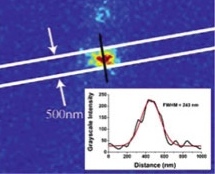
Recently Craighead Research Group at Corenll University reported their next “nano” breakthrough. They created a so-called “Nano-Lamp” - a microscopic collection of light-emitting fibers with dimensions of only a few hundred nanometers.
According to the research article published in “Nano Letters”, the scientists were able to create one of the smallest manmade source of light that world has ever seen. The light-emitting spots on the fibers measure less than 250 nm in diameter which makes this light source smaller than the wavelength of light that they emit - 600nm. The fibers are made from a polymer with ruthenium-based molecules using a complex technique called - electrospinning - when a small droplet of polymer solution is placed on a metal needle tip followed by application of a high voltage between the tip and gold electrodes in a silicon base placed a few millimeters away.
A light-emitting nanofiber spans gold electrodes that are 500 nm apart and ruthenium-based molecules embedded in the fiber light up when exposed to an electric field of 3-4 V. An interesting fact is that when researches applied a high voltage of 100 volts, the orange light was bright enough to be seen by a human eye in the dark.
'Tabletop' fusion back
After a rather rough ride in the 1990's table top fusion or fusion of light atomic nucleii at room temprature (as opposed to the core of the sun) is making a comeback. The US Navy has thrown its weight behind one of the new genere of experiments in this line. Excerpt from Dailytech.com :
Cold fusion, the ability to generate nuclear power at room temperatures, has proven to be a highly elusive feat. In fact, it is considered by many experts to be a mere pipe dream -- a potentially unlimited source of clean energy that remains tantalizing, but so far unattainable.
However, a recently published academic paper from the Navy's Space and Naval Warfare Systems Center (SPAWAR) in San Diego throws cold water on skeptics of cold fusion. Appearing in the respected journal Naturwissenschaften, which counts Albert Einstein among its distinguished authors, the article claims that Spawar scientists Stanislaw Szpak and Pamela Mosier-Boss have achieved a low energy nuclear reaction (LENR) that can be replicated and verified by the scientific community.
Cold fusion has gotten the cold shoulder from serious nuclear physicists since 1989, when Stanley Pons and Martin Fleischmann were unable to substantiate their sensational claims that deuterium nuclei could be forced to fuse and release excess energy at room temperature. Spawar researchers apparently kept the faith, however, and continued to refine the procedure by experimenting with new fusionable materials.
Szpak and Boss now claim to have succeeded at last by coating a thin wire with palladium and deuterium, then subjected it to magnetic and electric fields. The researchers have offered plastic films called CR-39 detectors as evidence that charged particles have emerging from their reaction experiments.
The Spawar method shows promise, particularly in terms of being easily reproduced and verified by other institutions. Such verification is essential to widespread acceptance of the apparent breakthrough, an important precursor to scientists receiving the necessary funding to fuel additional research in the field.
Cold fusion, the ability to generate nuclear power at room temperatures, has proven to be a highly elusive feat. In fact, it is considered by many experts to be a mere pipe dream -- a potentially unlimited source of clean energy that remains tantalizing, but so far unattainable.
However, a recently published academic paper from the Navy's Space and Naval Warfare Systems Center (SPAWAR) in San Diego throws cold water on skeptics of cold fusion. Appearing in the respected journal Naturwissenschaften, which counts Albert Einstein among its distinguished authors, the article claims that Spawar scientists Stanislaw Szpak and Pamela Mosier-Boss have achieved a low energy nuclear reaction (LENR) that can be replicated and verified by the scientific community.
Cold fusion has gotten the cold shoulder from serious nuclear physicists since 1989, when Stanley Pons and Martin Fleischmann were unable to substantiate their sensational claims that deuterium nuclei could be forced to fuse and release excess energy at room temperature. Spawar researchers apparently kept the faith, however, and continued to refine the procedure by experimenting with new fusionable materials.
Szpak and Boss now claim to have succeeded at last by coating a thin wire with palladium and deuterium, then subjected it to magnetic and electric fields. The researchers have offered plastic films called CR-39 detectors as evidence that charged particles have emerging from their reaction experiments.
The Spawar method shows promise, particularly in terms of being easily reproduced and verified by other institutions. Such verification is essential to widespread acceptance of the apparent breakthrough, an important precursor to scientists receiving the necessary funding to fuel additional research in the field.
Wednesday, May 02, 2007
Highway power

wind turbines powered by the breeze generated from the renowned Jersey highways, to help reduce the amount of electricity being used.
The big shocker of this story? The wind turbines won’t be built on the side of the highway. They will be built in under the road. It is proposed to use the power thus generated to run a light railway. Not bad as a lateral idea. How much pertol one needs to burn to make the wind turbines break even is anyones guess :)
Monday, April 30, 2007
Solar plant in ontario

The canadians are putting us a 40 MW solar plant. For a country blessed with so much hydro power this is a move that smacks of vision. Contrast this with Bangalore's bescom whose inept babus claim (on paper) that the situation is normal. This is when the average banglorean faces 2- 6 hours of 'unscheduled' disruption. What the government cannot fix, the people should.
Read more here
Friday, April 27, 2007
The LED pie

Japan as ever seems to be way ahead of the others. The curious thing is how desperate the Chinese are to sell their semi-conductor even though they make a hell of a lot less than the Japanese. The taiwanese production is not a surprise. Funnily the larger the volume the greater the price. That is the led market for you. Read more here.
Light guides from Kaye Effect
Thursday, April 26, 2007
Algae based bio reactors

Something that is much better than all the fuss about corn ethanol which is a silly idea on stilts. This can be viewed as cellulosic ethanol's first and possibly best entry into the industry. From the article in Green power :
BioKing Green Energy NV has developed new, high performance and continuous photo-bioreactors for algae for the purpose of producing biodiesel. BioKing Green Energy NV is a recently formed subsidiary, fully owned by BioKing Inc. It will engage in research and development of algae cultivation as an energy source for the production of biodiesel, which is an economically feasible and eco-friendly alternative to petroleum-based fuels. The production facilities for algae bio fuels will be based in the Netherlands, Spain and Portugal.
Hans and Marco van de Ven, founders of BioKing states: “With the increasing interest in biodiesel as an alternative to petrodiesel, many have looked at the possibility of growing even more oilseed crops as a solution to the problem of peak oil. However, there are two problems with this approach. Firstly, cultivation of even more oilseed crops will usurp valuable space needed to grow food crops to feed mankind. And secondly, traditional oilseed crops are not the most productive or efficient source of vegetable oil. Micro-algae have the highest potential of energy yield in vegetable oil crops. Some species of algae are ideally suited for biodiesel production due to their high oil content, some as much as 50 percent, and their extremely fast growth rates. They can grow in adverse conditions like deserts and saline water. That is why algae are the crop of the future.”
BioKing Inc. is a developer of scalable photo-bioreactors for the production of biodiesel developed with patented technology. They also produce other valuable bio-commodities produced from algae oil. This technology has the potential to dramatically improve biodiesel yields from algae oil.
“After only 3.5 hours inside the newly designed continuous photo-bioreactor system algae can be collected and processed,” van de Ven states. “ With our fast growing algae and our advanced photo-bioreactor it only takes four days to be in full production and to collect the first algae. And the cost of biodiesel feedstock will only be 5 to 10 cents a liter.”
3D nano tower arrays - 2
More details emerge on the latest in Photo voltaics Excerpt below :
The GTRI photovoltaic cells trap light between their tower structures, which are about 100 microns tall, 40 microns by 40 microns square, 10 microns apart—and built from arrays containing millions of vertically-aligned carbon nanotubes. Conventional flat solar cells reflect a significant portion of the light that strikes them, reducing the amount of energy they absorb.
Because the tower structures can trap and absorb light received from many different angles, the new cells remain efficient even when the sun is not directly overhead. That could allow them to be used on spacecraft without the mechanical aiming systems that maintain a constant orientation to the sun, reducing weight and complexity – and improving reliability.
“The efficiency of our cells increases as the sunlight goes away from perpendicular, so we may not need mechanical arrays to rotate our cells,” Ready noted.
The ability of the 3D cells to absorb virtually all of the light that strikes them could also enable improvements in the efficiency with which the cells convert the photons they absorb into electrical current.
In conventional flat solar cells, the photovoltaic coatings must be thick enough to capture the photons, whose energy then liberates electrons from the photovoltaic materials to create electrical current. However, each mobile electron leaves behind a “hole” in the atomic matrix of the coating. The longer it takes electrons to exit the PV material, the more likely it is that they will recombine with a hole—reducing the electrical current.
Because the 3D cells absorb more of the photons than conventional cells, their coatings can be made thinner, allowing the electrons to exit more quickly, reducing the likelihood that recombination will take place. That boosts the “quantum efficiency” – the rate at which absorbed photons are converted to electrons – of the 3D cells.
Fabrication of the cells begins with a silicon wafer, which can also serve as the solar cell’s bottom junction. The researchers first coat the wafer with a thin layer of iron using a photolithography process that can create a wide variety of patterns. The patterned wafer is then placed into a furnace heated to 780 degrees Celsius. Hydrocarbon gases are then flowed into furnace, where the carbon and hydrogen separate. In a process known as chemical vapor deposition, the carbon grows arrays of multi-walled carbon nanotubes atop the iron patterns.
Once the carbon nanotube towers have been grown, the researchers use a process known as molecular beam epitaxy to coat them with cadmium telluride (CdTe) and cadmium sulfide (CdS) which serve as the p-type and n-type photovoltaic layers. Atop that, a thin coating of indium tin oxide, a clear conducting material, is added to serve as the cell’s top electrode.
In the finished cells, the carbon nanotube arrays serve both as support for the 3D arrays and as a conductor connecting the photovoltaic materials to the silicon wafer.
The researchers chose to make their prototypes cells from the cadmium materials because they were familiar with them from other research. However, a broad range of other photovoltaic materials could also be used, and selecting the best material for specific applications will be a goal of future research.
Ready also wants to study the optimal heights and spacing for the towers, and to determine the trade-offs between spacing and the angle at which the light hits the structures.
The new cells face several hurdles before they can be commercially produced. Testing must verify their ability to survive launch and operation in space, for instance. And production techniques will have to scaled up from the current two-inch laboratory prototypes.
“We have demonstrated that we can extract electrons using this approach,” Ready said. “Now we need to get a good baseline to see where we compare to existing materials, how to optimize this and what’s needed to advance this technology.”
Intellectual Property Partners of Atlanta holds the rights to the 3D solar cell design and is seeking partners to commercialize the technology.
Another commercialization path is being followed by an Ohio company, NewCyte, which is partnering with GTRI to use the 3D approach for terrestrial solar cells. The Air Force Office of Scientific Research has awarded the company a Small Business Technology Transfer (STTR) grant to develop the technology.
“NewCyte has patent pending, low cost technology for depositing semiconductor layers directly on individual fullerenes,” explained Dennis J. Flood, NewCyte’s president and CTO. “We are using our technology to grow the same semiconductor layers on the carbon nanotube towers that GTRI has already demonstrated. Our goal is to achieve performance and cost levels that will make solar cells using the GTRI 3D cell structure competitive in the broader terrestrial solar cell market.”
Nano towers were covered in this blog previously.
The GTRI photovoltaic cells trap light between their tower structures, which are about 100 microns tall, 40 microns by 40 microns square, 10 microns apart—and built from arrays containing millions of vertically-aligned carbon nanotubes. Conventional flat solar cells reflect a significant portion of the light that strikes them, reducing the amount of energy they absorb.
Because the tower structures can trap and absorb light received from many different angles, the new cells remain efficient even when the sun is not directly overhead. That could allow them to be used on spacecraft without the mechanical aiming systems that maintain a constant orientation to the sun, reducing weight and complexity – and improving reliability.
“The efficiency of our cells increases as the sunlight goes away from perpendicular, so we may not need mechanical arrays to rotate our cells,” Ready noted.
The ability of the 3D cells to absorb virtually all of the light that strikes them could also enable improvements in the efficiency with which the cells convert the photons they absorb into electrical current.
In conventional flat solar cells, the photovoltaic coatings must be thick enough to capture the photons, whose energy then liberates electrons from the photovoltaic materials to create electrical current. However, each mobile electron leaves behind a “hole” in the atomic matrix of the coating. The longer it takes electrons to exit the PV material, the more likely it is that they will recombine with a hole—reducing the electrical current.
Because the 3D cells absorb more of the photons than conventional cells, their coatings can be made thinner, allowing the electrons to exit more quickly, reducing the likelihood that recombination will take place. That boosts the “quantum efficiency” – the rate at which absorbed photons are converted to electrons – of the 3D cells.
Fabrication of the cells begins with a silicon wafer, which can also serve as the solar cell’s bottom junction. The researchers first coat the wafer with a thin layer of iron using a photolithography process that can create a wide variety of patterns. The patterned wafer is then placed into a furnace heated to 780 degrees Celsius. Hydrocarbon gases are then flowed into furnace, where the carbon and hydrogen separate. In a process known as chemical vapor deposition, the carbon grows arrays of multi-walled carbon nanotubes atop the iron patterns.
Once the carbon nanotube towers have been grown, the researchers use a process known as molecular beam epitaxy to coat them with cadmium telluride (CdTe) and cadmium sulfide (CdS) which serve as the p-type and n-type photovoltaic layers. Atop that, a thin coating of indium tin oxide, a clear conducting material, is added to serve as the cell’s top electrode.
In the finished cells, the carbon nanotube arrays serve both as support for the 3D arrays and as a conductor connecting the photovoltaic materials to the silicon wafer.
The researchers chose to make their prototypes cells from the cadmium materials because they were familiar with them from other research. However, a broad range of other photovoltaic materials could also be used, and selecting the best material for specific applications will be a goal of future research.
Ready also wants to study the optimal heights and spacing for the towers, and to determine the trade-offs between spacing and the angle at which the light hits the structures.
The new cells face several hurdles before they can be commercially produced. Testing must verify their ability to survive launch and operation in space, for instance. And production techniques will have to scaled up from the current two-inch laboratory prototypes.
“We have demonstrated that we can extract electrons using this approach,” Ready said. “Now we need to get a good baseline to see where we compare to existing materials, how to optimize this and what’s needed to advance this technology.”
Intellectual Property Partners of Atlanta holds the rights to the 3D solar cell design and is seeking partners to commercialize the technology.
Another commercialization path is being followed by an Ohio company, NewCyte, which is partnering with GTRI to use the 3D approach for terrestrial solar cells. The Air Force Office of Scientific Research has awarded the company a Small Business Technology Transfer (STTR) grant to develop the technology.
“NewCyte has patent pending, low cost technology for depositing semiconductor layers directly on individual fullerenes,” explained Dennis J. Flood, NewCyte’s president and CTO. “We are using our technology to grow the same semiconductor layers on the carbon nanotube towers that GTRI has already demonstrated. Our goal is to achieve performance and cost levels that will make solar cells using the GTRI 3D cell structure competitive in the broader terrestrial solar cell market.”
Nano towers were covered in this blog previously.
Nemesis found

The prescience of Issac Asimov, the grand old man of science fiction, is scary. For readers of science fiction, 'Nemesis' was a seminal book about (mostly) superluminal flight and the discovery of a red dwarf which is a 'unknown' binary to our own sun. The scary bit is that there is a rocky planet in orbit around the red dwarf that has liquid water and an alien intelligence based on prokaryote lie forms ( a rocky water sustaining planet around a red dwarf is astronomically very rare). In a recent discovery, Euro astronomers have found a planet that matches this in spec a mere 20 light years from earth. So to Nemesis !
Excerpt from the BBC:
Astronomers have found the most Earth-like planet outside our Solar System to date, a world which could have water running on its surface.
The planet orbits the faint star Gliese 581, which is 20.5 light-years away in the constellation Libra.
Scientists made the discovery using the Eso 3.6m Telescope in Chile.
They say the benign temperatures on the planet mean any water there could exist in liquid form, and this raises the chances it could also harbour life.
"We have estimated that the mean temperature of this 'super-Earth' lies between 0 and 40 degrees Celsius, and water would thus be liquid," explained Stephane Udry of the Geneva Observatory, lead author of the scientific paper reporting the result. Moreover, its radius should be only 1.5 times the Earth's radius, and models predict that the planet should be either rocky - like our Earth - or covered with oceans."
Xavier Delfosse, a member of the team from Grenoble University, added: "Liquid water is critical to life as we know it."
He believes the planet may now become a very important target for future space missions dedicated to the search for extra-terrestrial life.
These missions will put telescopes in space that can discern the tell-tale light "signatures" that might be associated with biological processes.
The observatories would seek to identify trace atmospheric gases such as methane, and even markers for chlorophyll, the pigment in Earth plants that plays a critical role in photosynthesis.
Given the recent theories on chlorophyll, they should also look for retinal which was the photosynthetic molecule that preceded chlorophyll on earth and can still be found in halobacteria.
The exoplanet - as astronomers call planets around a star other than the Sun - is the smallest yet found, and completes a full orbit of its parent star in just 13 days.
Indeed, it is 14 times closer to its star than the Earth is to our Sun.
However, given that the host star is smaller and colder than the Sun - and thus less luminous - the planet nevertheless lies in the "habitable zone", the region around a star where water could be liquid.
Gliese 581 was identified at the European Southern Observatory (Eso) facility at La Silla in the Atacama Desert.
To make their discovery, researchers used a very sensitive instrument that can measure tiny changes in the velocity of a star as it experiences the gravitational tug of a nearby planet.
Astronomers are stuck with such indirect methods of detection because current telescope technology struggles to image very distant and faint objects - especially when they orbit close to the glare of a star.
The Gliese 581 system has now yielded three planets: the new super-Earth, a 15 Earth-mass planet orbiting even closer to the parent star, and an eight Earth-mass planet that lies further out.
Gliese 581 is much cooler and dimmer than our own Sun
The latest discovery has created tremendous excitement among scientists.
Of the more than 200 exoplanets so far discovered, a great many are Jupiter-like gas giants that experience blazing temperatures because they orbit close to hot stars.
The Gliese 581 super-Earth is in what scientists call the "Goldilocks Zone" where temperatures "are just right" for life to have a chance to exist.
Commenting on the discovery, Alison Boyle, the curator of astronomy at London's Science Museum, said: "Of all the planets we've found around other stars, this is the one that looks as though it might have the right ingredients for life.
"It's 20 light-years away and so we won't be going there anytime soon, but with new kinds of propulsion technology that could change in the future. And obviously we'll be training some powerful telescopes on it to see what we can see," she told BBC News.
"'Is there life anywhere else?' is a fundamental question we all ask."
Professor Glenn White at the Rutherford Appleton Laboratory is helping to develop the European Space Agency's Darwin mission, which will scan the nearby Universe, looking for signs of life on Earth-like planets. He said: "This is an important step in the search for true Earth-like exoplanets.
"As the methods become more and more refined, astronomers are narrowing in on the ultimate goal - the detection of a true Earth-like planet elsewhere.
"Obviously this newly discovered planet and its companions in the Gliese 581 system will become prominent targets for missions like Esa's Darwin and Nasa's Terrestrial planet Finder when they fly in about a decade."
Subscribe to:
Posts (Atom)